
When rain falls over Lyndall Murray’s home in northern NSW, it brings her immense anxiety.
“It’s so scary when these rains come in, because we haven’t recovered from the last flood,” she says. “If we get another one, we’re not prepared.”
Lyndall, a surfer and community advocate, was actively involved in the community-led emergency response to the March 2022 floods, running a call centre from her own lounge room for 16 days.

March 2022 changed many lives — the memory is still raw for NSW/Qld border area residents. Photo: Beau Emerton
That weather event destroyed homes and displaced families, with communities still in recovery mode. Despite ongoing efforts and funding, Lyndall believes the government’s response remains inadequate. “Not enough community consultation has been done to learn from the 2022 disaster.”
Remember that? The Tweed Armada
Two years on, time is running out for consultation. Summer has arrived, bringing the northern monsoon season in full force. The Gold Coast and northern NSW are already dealing with heavy rainfall and flooding, part of an ongoing severe weather trend that has led to unprecedented river run-off.
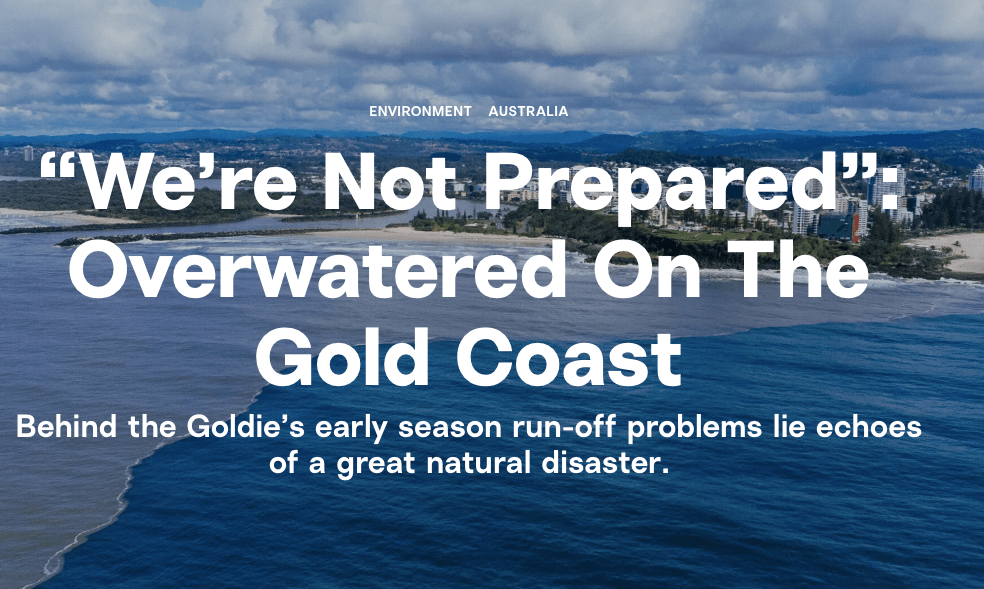
This influx of floodwater has dropped discoloured water along major beaches, raising health and safety concerns for us and many other coast-dwellers. So, what’s exactly happening with the weather and the waves?

The Tweed River flush. One thing about heavy rain run-off — you can’t miss it. Photo: Andrew Shield

Right now: run-off from Cudgen Creek stains waters just off Kingscliff. With a wetter than usual summer on the cards, expect more of this in coming months — and maybe more swell. Photo: Hannah Anderson

Still tempting, though. Photo: Shield
Low pressure troughs brought record-breaking rainfall to parts of Queensland and north-eastern NSW in November, with Coolangatta nearly doubling last year’s 188 mm to 381.6 mm. Major flooding occurred in catchments near the Gold Coast as heavy rain fell on already saturated soils, overwhelming waterways, flushing debris and pollutants into the ocean, impacting water quality, and even re-shaping surf spots. The iconic Gold Coast points became less reliable, with sand shifts and rips.
The Bureau of Meteorology has predicted an increased chance of above-average rainfall for the summer. Some stations in south-eastern Queensland and north-eastern NSW have already recorded their highest daily rainfall for December, including Byron Bay with a wild 97.4 mm in 24 hours on December 1.
Surfline’s forecast guru Hugh McDowell suggests that the BoM’s forecast is likely influenced by warmer-than-average sea surface temperatures in the Tasman Sea and La Niña-like atmospheric conditions. Hugh highlights the paradox here: The same weather that brings flooding may also bring better surf.

Surfline sea surface temperature chart this week. More and more warm water is pooling into the SW Pacific, a trend associated with La Niña, and with extra rainfall along the east coast.
“Peak swell heights are late summer to early autumn on the Gold Coast, which tie into peak cyclone season,” he says. “It’s also when the trade-winds start coming a bit further south, so we typically see more swell out of the east at this time of year. The summer outlook suggests that could be enhanced, and we often see those trends enhanced with La Niña years. We might see more rainfall, but as a consequence, we also might see more swell as well.”
The climate drivers are here: Australia’s Summer Outlook 2024/25
And the possibility of cyclogenesis!: Australia’s Tropical Cyclone Outlook
It’s a dynamic balance – great waves but potentially hazardous water.
Run-off from flooding is a growing health concern for the local surf community. Pollutants in the water are causing gastrointestinal illnesses and other issues for those who enter the surf. Harry Gordon of Surfrider Foundation experienced this first-hand after a bodysurfing competition following heavy rain. “I had gastro for three days after swallowing water, and another competitor was sick for about 24–36 hours,” he recalls.

March ’22 was an outlier in more ways than one. Greenmount into Coolie, and water determined not to mix. Photo: Swilly
Harry is part of Surfrider Foundation’s Blue Water Task Force (BWTF), working to address these issues by monitoring coastal water quality. Volunteers collect samples monthly, testing for harmful bacteria linked to health risks. Results are shared using a traffic light system, empowering communities to make informed decisions.
Testing on December 1 identified extremely high levels of Enterococcus bacteria – a marker of faecal contamination – at Little Duranbah (>24,196 MPN/100mL), Duranbah (4,352 MPN/100mL), and Snapper (332 MPN/100mL). These veer well above Commonwealth Guidelines for Managing Risk in Recreational Water, which sit at >500 MPN/100mL for high illness risk and >200 MPN/100mL for elevated health risks.
Harry says Surfrider Foundation wish to expand the program, but right now, without daily testing, Harry stresses that swimming and surfing is still very much at your own risk. “I’ll wear earplugs and hold my breath underwater to avoid taking in contaminated water.”

If you’re a supergrommet, you’re gonna go anyway. Hopefully Leihani Zoric got away with it. Leihani at Byron, in the middle of the northern rivers’ flush. Photo: Shield
The City of Gold Coast monitors water quality more regularly, but it’s still not on a day-to-day basis. Monitoring is rostered every 18 days and following heavy rainfall. Should water quality testing find elevated results, the City of Gold Coast will initiate site investigations and community notifications, on the City alerts page and signage around affected areas. While the City does not currently publish its water quality results, a spokesperson says, “We are working to develop a platform to provide water quality advice to the community.”
The City of Gold Coast spokesperson also states: “There is a strong link between rainfall events and the health of our waterways so as a precaution always avoid swimming for at least one day after heavy rain at open beaches and at least three days after heavy rain at rivers, lakes and estuaries in water that looks discoloured, murky, or smells unpleasant, and near stormwater drains.”
Volume 90%
Above: Surfline cam rewind of the Tweed rivermouth in semi-flood. Water pressure from the Tweed during run-off events tends to change sandflow, affecting Duranbah and very probably Snapper over longer periods.
Testing ensures water is safe for recreational use, but traditional methods require up to 72 hours to process results. To address delays, Beachwatch in NSW developed a predictive model offering water quality forecasts. These forecasts, updated twice daily, guide swimmers on when and where it’s safe to swim.
But just like weather forecasts, water quality predictions aren’t always accurate, and even if the water looks clear, it can still have hidden contaminants. Water quality can vary depending on where and how much it rains and regular tests might not catch everything. Floodwaters can also stick around for weeks, as we saw during the 2022 floods, making things even more murky.
One thing is clear though: Regardless of risk, where there’s swell, there will always be surfers ready to jump in.

Mick Fanning during the ’22 floods, when jetskis came to mean something a bit more crucial than step-offs. Photo: Shield
That urge to get involved played a critical role in the rescue efforts of 2022, with individuals like Mick Fanning and Joel Parkinson carrying out search and rescue efforts for days at a time.
“The surfing community miraculously pulled off a military-style operation,” says Lyndall Murray. “It was nothing like I’d ever seen before.”
Lyndall believes it’s volunteers like Mick and Joel, who are well-versed in water skills and safety, who will be called on again as severe weather becomes the norm over the warmer months. She urges ocean lovers to advocate for long-term solutions. “We need to push for sustainable practices that ensure the health of our waterways for generations to come.”
Near-term forecast goodies: Sunshine Coast | Gold Coast | Northern NSW
 Lisette Drew